

Service & commissioning
Backed by people who know Mitsubishi marine engines
OPS supports Mitsubishi marine and industrial engines across Australia — including Tasmania — plus New Zealand and the Pacific Islands, backed by our own team and workshops in Singapore, Jakarta and Surabaya. For genuine spare parts, seeParts.
Get sales support
Email sales@oceaniapower.com.au with your engine or vessel details and we'll connect you with the right team, for service, commissioning or ongoing support.
Service coverage
- Australia-wide
OPS supports customers across Australia, including Tasmania, with commissioning and service carried out by our own team, and genuine parts kept moving through our distributor and dealer network.
- New Zealand & Pacific Islands
The same team supports operators across New Zealand and the Pacific Islands, backed by genuine MHI parts and MHI's own factory support.
- Regional workshops
Engine, transmission and electrical workshops in Singapore, Jakarta and Surabaya, staffed by service teams very experienced in Mitsubishi marine engines.
What OPS service covers
Spare parts
Genuine MHI spare parts are stocked in our own Wangara warehouse, with access to MHI's Singapore parts hub and ordering system for anything we don't hold on the shelf, plus dealer and distributor partners for filters, lubricants and accessories — the same network that keeps every item on the maintenance schedule below in stock, not just the common ones. See Parts to search the full catalogue.
Maintenance schedule
MHI's own maintenance schedule for engines like the S6R and S16R2 runs on service hours, not a fixed season. Each interval below also carries everything due at the shorter intervals above it.
- First 100 hours (once)
- Oil, oil filter and fuel filter replaced; valve clearance inspected and adjusted.
- Every 250 hours
- Belts and belt tension inspected and adjusted; pre-cleaner cleaned, inspected and replaced.
- Every 500 hours
- Zinc rod inspected, governor oil filter replaced.
- Every 1,000 hours
- Turbocharger rotor checked for movement and looseness; fuel injection nozzles inspected and adjusted.
- Every 2,000 hours or a year
- High-pressure fuel lines, injection nozzle tips and the seawater pump impeller replaced — whichever comes first.
- Every 4,000 hours or 2.5 years — top overhaul
- The cylinder head comes off to inspect the valve mechanism and cylinder liners.
- Every 8,000 hours or 5 years — major overhaul
- Pistons checked; main and connecting rod bearings, cylinder liners and piston rings replaced; turbocharger fully overhauled. On MHI's larger models, the manual is explicit that this isn't field work: the engine goes back to the factory for complete disassembly.
Many of the items on that schedule are marked in MHI's own manual as needing special tools or large-scale maintenance, with the manual's own instruction to contact your MHIET dealer for that work — OPS is MHI's exclusive distributor for this engine range in the region.
Beyond the schedule, OPS also handles ongoing vessel maintenance and refit work, including acting as owner's representative.
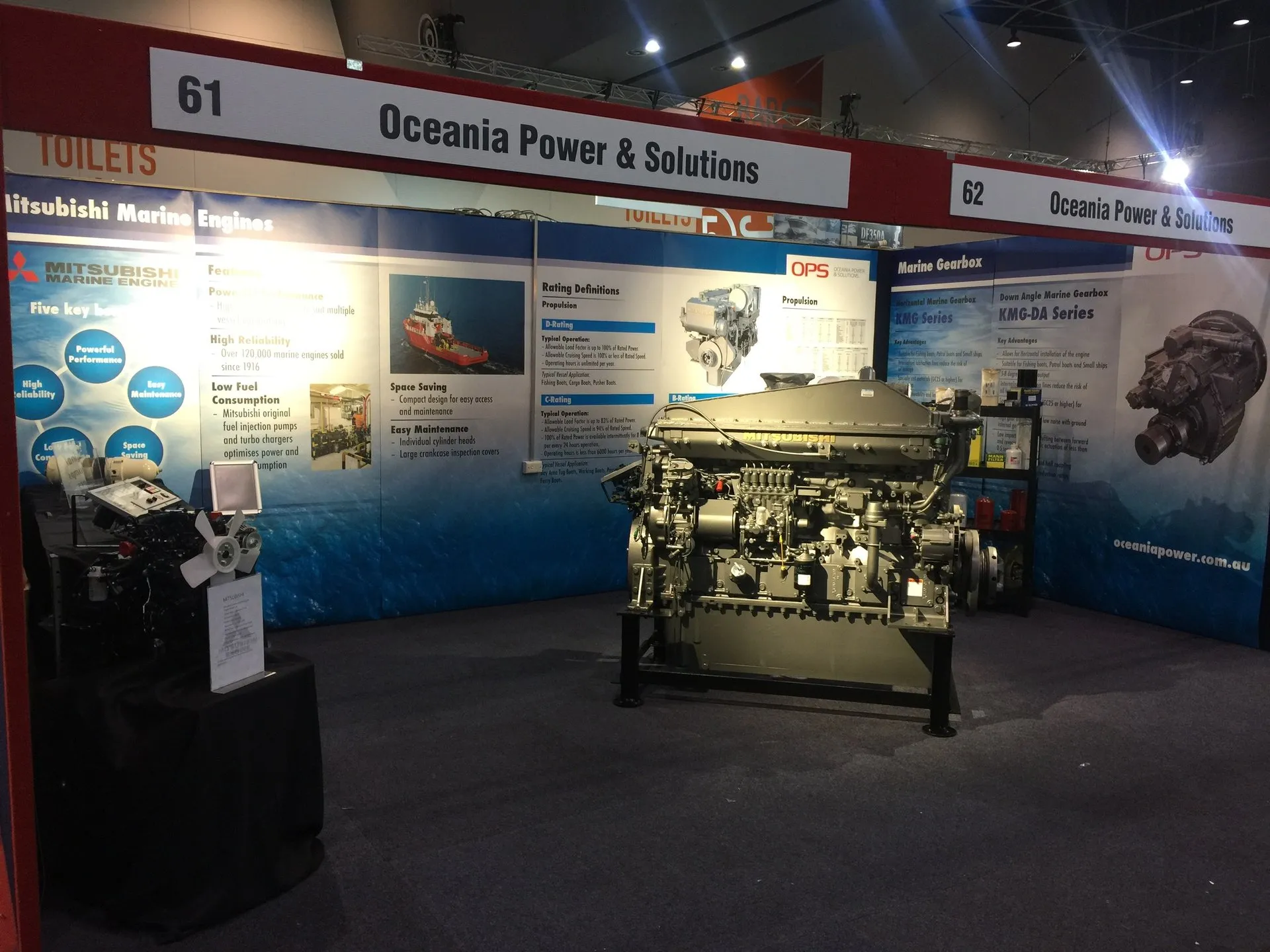
Backed by a real, established presence
OPS shows up at the industry events that matter — not just a phone number and a warehouse. The same team you'll talk to for service or commissioning support is the one representing OPS on the floor.
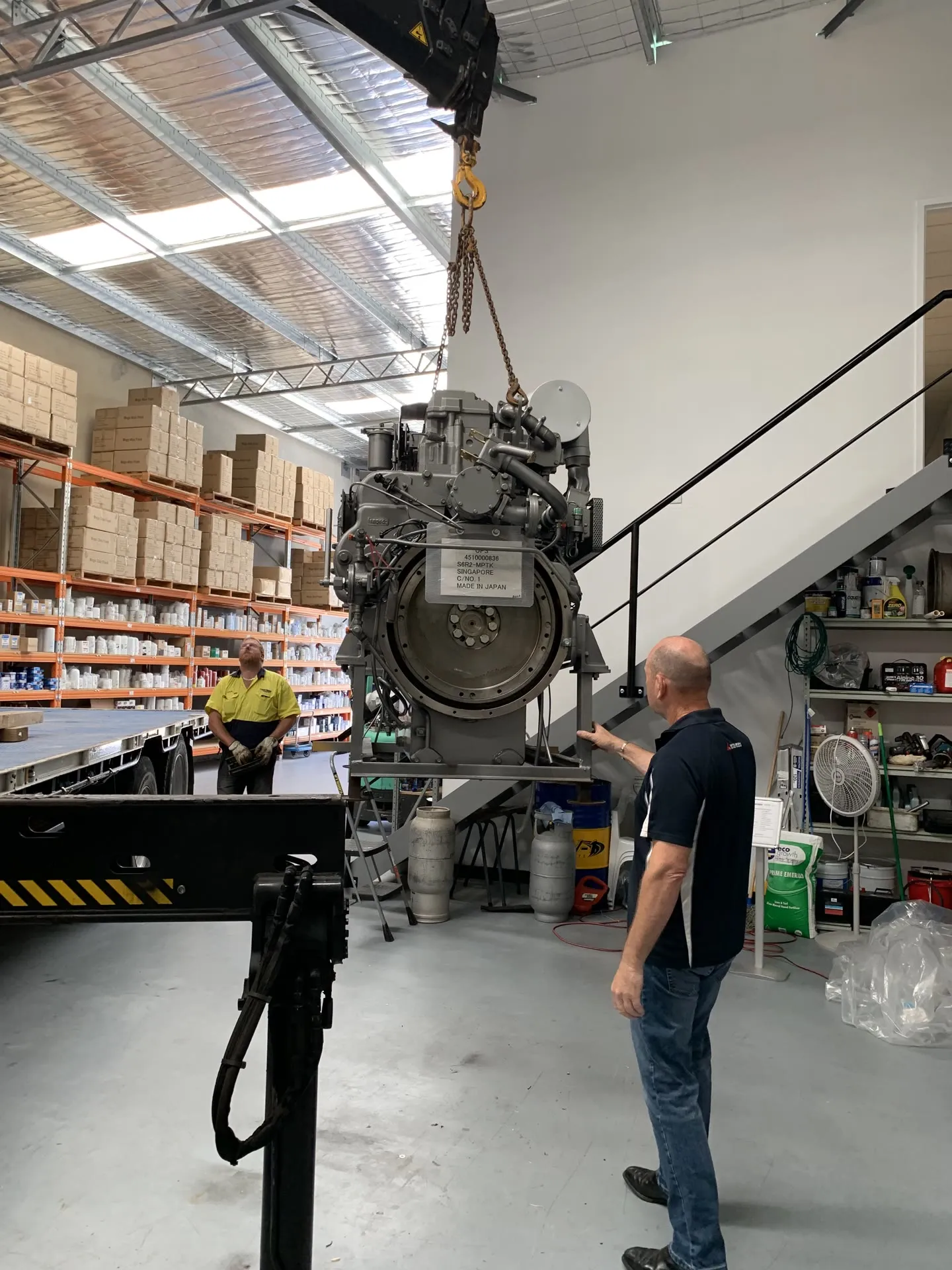
The last step, not an afterthought
Before first start
Commissioning starts before the engine ever turns over. MHI's own manual walks through preparing the fuel system — checking the tank and feed pipe are clean, filling it, then bleeding air from the oil-water separator, fuel filter and return line in that order — before the first start.
What follows is a 50-hour break-in at light load, because a new engine's components aren't yet properly lubricated and fitted to each other; running one hard in that window shortens its working life rather than proving it.
What commissioning covers
On a propulsion installation that sits alongside confirming the fuel and water piping, exhaust and intake sizing and engine mounting are right, and a sea trial before the vessel goes to work — the standard checkpoints for commissioning an engine like this, wherever it's done.
Every engine OPS supplies is commissioned by our own team, using the same stock and parts network already described above. It's the outcome everything else on this page is built toward: an engine or gen-set, marine or industrial, ready to work.